Feature Education
Hearing Aid Technology Explained: Features That Actually Matter
The hearing aid market is full of technical terminology. Here's what the key features actually mean and why they matter for your hearing.
Digital Signal Processing (DSP)
Digital signal processing is the foundational technology that separates modern hearing aids from simple amplifiers. A DSP chip continuously analyzes incoming sound, classifies it, and applies selective amplification based on the frequency content and characteristics of the sound. Rather than making everything louder, DSP boosts the specific frequencies where your hearing is weakest — typically the 1,000–4,000 Hz range where speech consonants are concentrated — while leaving other frequencies less amplified. The result is clearer, more intelligible speech without an overall volume increase that would make background noise unbearable.
Noise Reduction
Noise reduction algorithms work alongside DSP to identify and suppress non-speech background sounds. By analyzing patterns in incoming audio, the device identifies sounds that lack the characteristics of human speech (steady-state noise like air conditioning or crowd chatter) and reduces their amplification while maintaining or enhancing speech amplification. The sophistication of the noise reduction system significantly determines how well a hearing aid performs in challenging real-world environments like restaurants, outdoor settings, and social gatherings.
Directional Microphones
Higher-quality hearing aids use multiple microphones to identify the direction from which sounds are coming. By giving preference to sounds arriving from the front (where the speaker's mouth typically is) and reducing sounds arriving from behind and the sides, directional microphone systems dramatically improve speech clarity in situations where the speaker is in front of you and background noise is coming from other directions. This is one of the features that most distinguishes advanced OTC and prescription hearing aids from basic devices.
Feedback Cancellation
Acoustic feedback — the high-pitched whistling that everyone associates with hearing aids — occurs when amplified sound escapes from the ear canal, re-enters the microphone, and is amplified again in a loop. Feedback cancellation systems continuously monitor for this feedback loop and introduce a cancellation signal to suppress it before it reaches an audible level. Without effective feedback cancellation, close proximity to other people, phone use, or touching the hearing aid can trigger uncomfortable and disruptive whistling.
Rechargeable vs. Disposable Batteries
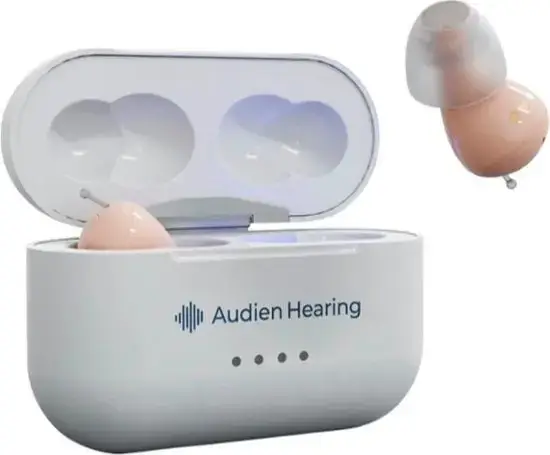
Traditional hearing aids used small zinc-air disposable batteries (sizes 10, 312, 13, or 675) that typically last 5–14 days. Changing these batteries requires reasonable manual dexterity — which can be challenging for older adults or those with arthritis. Modern OTC hearing aids like Audien use lithium-ion rechargeable batteries that charge in the included case, providing 20+ hours of use per charge. For most users, the rechargeable design is significantly more convenient and eliminates the ongoing cost of disposable batteries.
Bluetooth and App Connectivity
Some OTC hearing aids (and most premium prescription aids) offer Bluetooth connectivity to smartphones, enabling direct audio streaming from calls, music, and media, as well as app-based control of volume, program settings, and sometimes audiometric self-fitting. While Bluetooth adds functionality, it is not essential for many users — particularly those who prefer simple, no-app devices. Simpler models like Audien Atom provide all core hearing aid benefits without requiring a smartphone, which is appreciated by many older adults.
Form Factor: Behind-the-Ear (BTE) vs. In-the-Ear (ITE)
Behind-the-ear designs (like Audien) sit comfortably behind the ear with a small tube or wire delivering sound to an ear tip that fits in the ear canal. They are generally easier to fit, handle, and clean — making them the most practical choice for first-time users and those who want simple operation. In-the-ear designs fit entirely within the ear canal and are more discreet, but typically require professional fitting and can be trickier to insert and adjust, particularly for people with smaller ear canals or dexterity challenges.